Research
Our group studies collisionless plasmas in the extreme environments of black holes and neutron stars. We use plasma simulations and theoretical modeling to understand how compact objects power relativistic outflows and how particles are accelerated to produce the multiwavelength emission in these environments.
Fast Radio Bursts from Magnetars
Fast radio bursts (FRB) are millisecond-duration flashes of radio waves from distant astrophysical sources, with brightness temperatures so high that their emission must arise from coherent plasma processes. Their short durations point to compact objects, and the discovery of FRB-like radio bursts from a Galactic magnetar has strengthened the connection between at least some FRBs and magnetar activity. Yet the physical mechanism that converts magnetic energy in a magnetar environment into coherent radio emission remains an open problem.
We study how impulsive magnetic disturbances launched by crustal or magnetospheric activity propagate through magnetar magnetospheres, transfer energy to relativistic plasma, and produce observable radio and high-energy emission. This theme connects our work on Alfvén-wave-driven ejecta, nonlinear wave mode conversion, monster shocks, and coherent emission from magnetar environments.
Alfvén wave nonlinear breakout
Our earlier work has developed one possible scenario for FRB-like bursts from the Galactic magnetar: low-amplitude Alfvén waves from a magnetar quake may propagate to the outer magnetosphere and convert to “plasmoids” (closed magnetic loops) that accelerate away from the star, driving blast waves into the magnetar wind. The blast wave can produce the observed radio bursts through the synchrotron maser mechanism, and the magnetic reconnection behind the Alfven wave ejecta may produce the simultaneous X-ray bursts.
The movie on the right shows the energy density in the electromagnetic field and a bundle of magnetic field lines during the plasmoid ejection process, obtained from a fully 3D force-free simulation.
Read more: Yuan et al 2022, ApJ 933, 174; Yuan et al 2020, ApJL 900 L21
FRB emission from monster shocks in magnetar magnetospheres
Magnetar crustal activities may also fill the magnetosphere with fast magnetosonic waves. As these waves propagate outward, their relative amplitude with respect to the background dipole field grows with radius. As a result, they could become nonlinear within the magnetosphere, steepening into the so-called monster shocks, perhaps among the strongest shocks in the universe, with enormous upstream Lorentz factor. Coherent, GHz emission can be produced as precursor waves at the monster shock, especially near the magnetic equator of the magnetar. This could be another promising mechanism for FRBs, especially those from the Galactic magnetar.
The following video shows the evolution of the fast wave as it steepens into monster shocks, obtained from our axisymmetric, global particle-in-cell simulations.
The video shows the evolution of fast waves with different wavelengths. From left to right, the panels are: the toroidal electric field in the fast wave, the plasma density, the ratio between the magnitudes of the electric field and magnetic field, and the bulk Lorentz factor of the plasma. The monster shock forms at the left edge of the E≈B region, and the fluctuating E/B signal right in front of the shock is the precursor wave emission.
Read more: Bernardi, Yuan & Chen 2025, PRL 135, 265201; Chen et al 2022, arXiv:2210.13506
Collisionless Accretion onto Black Holes
Accretion onto black holes powers some of the most luminous and variable sources in the universe, from Galactic X-ray binaries to active galactic nuclei (AGN). In many low-luminosity systems, such as Sgr A* and M87*, the accreting plasma is so dilute that Coulomb collisions are rare, and the flow becomes essentially collisionless. In this regime, key questions such as how angular momentum is transported, how electrons and ions are heated, how magnetic flux accumulates near the horizon, and how relativistic jets are supplied with plasma require a kinetic plasma description. Our work uses global general-relativistic particle-in-cell simulations to study black-hole accretion from first principles and to connect kinetic plasma physics with horizon-scale observations.
Stable Collisionless Tori around Kerr Black Holes
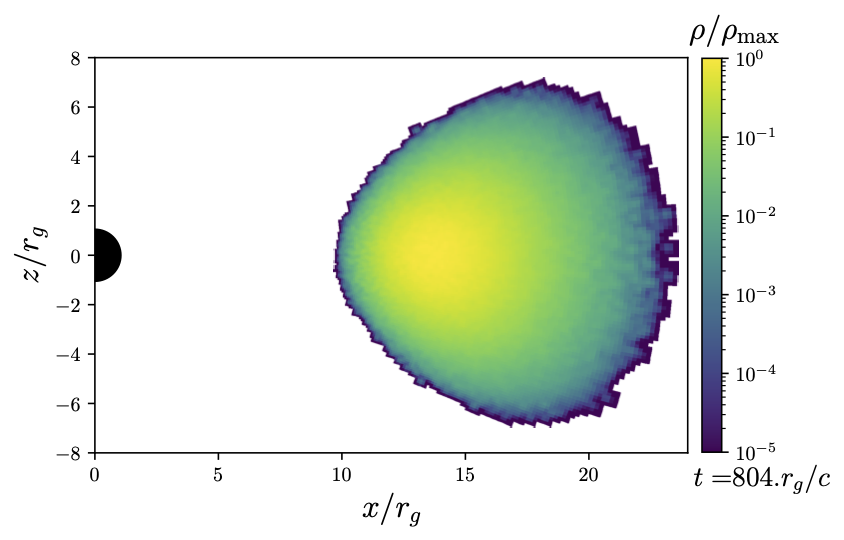
We would like to build a self-consistent model of collisionless accretion flows, starting from a physical initial condition where the gas supply near the black hole has finite angular momentum. A commonly used initial condition in GRMHD simulations is a hydrodynamic equilibrium assuming a perfect fluid, e.g. the Fishbone-Moncrief torus. However, this is not a kinetic equilibrium for a collisionless plasma.
We have developed a class of analytic kinetic equilibria of collisionless tori around a Kerr black hole—the Luepker torus. These kinetic equilibria serve as ideal test beds for us to further study the physics of collisionless accretion and jet launching.
Read more: Luepker, Yuan & Chen 2025, ApJ 996, 75
Collisionless Accretion of Finite-Angular-Momentum Plasma onto a Spinning Black Hole
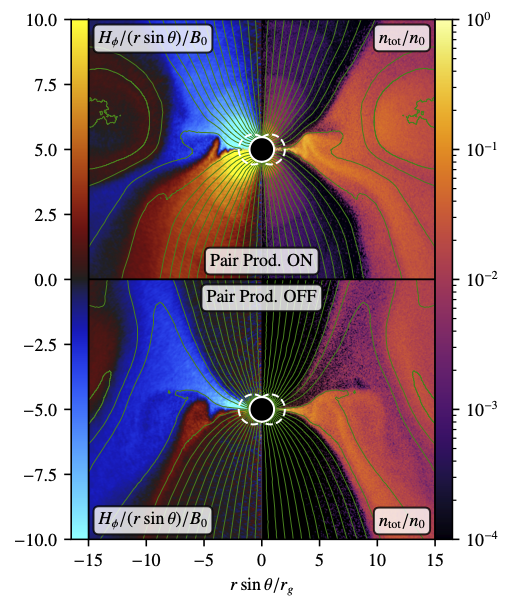
We used the Luepker torus initial condition to carry out the first global fully kinetic simulations of finite-angular-momentum accretion onto a spinning black hole, under the simplifying assumption of a pair plasma composition and 2D axisymmetry. The simulated accretion flow behaves remarkably similarly to the magnetically arrested disk (MAD) regime of ideal MHD, reproducing episodes of magnetic flux saturation and eruption typical of MADs. The resemblance to fluid models owes largely to kinetic instabilities, which regulate pressure anisotropy in the disk, allowing fluid terms to dominate the angular momentum transfer. In addition, by handling vacuum regions effectively, our kinetic approach probes the matter supply to the jet funnel. We observe no efficient penetration of the accreting material into this region, which suggests that a pair discharge may be required to sustain the Blandford-Znajek process.
The figure on the right shows the snapshots of magnetic field and density from two simulations, one with pair production and the other without, respectively.
Read more: Mehlhaff, Chen, Luepker, Yuan 2026, arXiv:2602.22168
Black Hole Magnetospheres and Jets
Physics of Pair-Producing Gaps in Black Hole Magnetospheres
In low luminosity AGN like M87, powerful jets can be launched by the supermassive black hole through the Blandford-Znajek (BZ) process. This requires sufficient plasma around the black hole to conduct the BZ current. When plasma runs low, regions with unscreened electric field will develop in the jet funnel, accelerating electrons to high energies that initiate electron-positron pair cascades on the background soft photons. The discharge dissipates energy extracted from the black hole and may produce γ-ray emission varying on time scales shorter than the event horizon light crossing time.
We use global 2D GRPIC simulations to study the physics of the pair discharge process from first principles.
The movie demonstrates the time dependent nature of the pair discharge process. From left to right, the panels show the average Lorentz factor of particles, electric field component parallel to the magnetic field, the pair production rate, and the plasma density, respectively. It can be seen that the gaps with nonzero D.B opens up quasiperiodically, produces pairs, and gets screened.
Read more: Yuan, Chen & Luepker 2025, ApJ 985, 159; Chen & Yuan 2020, ApJ 895, 121; Chen, Yuan & Yang 2018, ApJL 863, L31;
Magnetic Dissipation, Particle Acceleration, and Flares
Heating of the Compact X-ray Corona in Active Galactic Nuclei
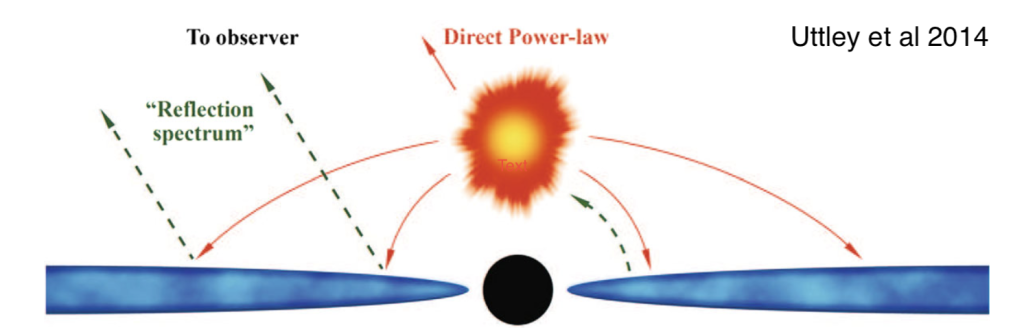
Seyfert galaxies are a kind of active galactic nuclei (AGN) where the central supermassive black hole accretes at slightly sub-Eddington rate. Some of them are radio quiet, namely, they do not have powerful jets, but they produce prominent X-ray emission, reaching up to 50% of the total AGN power. The X-ray is believed to be produced in a hot corona around the accretion disk. Recent X-ray reverberation mapping and microlensing measurements have shown that the corona is quite compact, not larger than a few tens of the black hole gravitational radii in size.
Since these galaxies do not have jets, we consider the possibility that the compact X-ray corona may be powered by small scale flux tubes near the black hole that are attached to the accretion disk. Due to the continuous shear provided by the disk motion or the black hole-disk relative motion, the flux tubes may get inflated and tangled up especially near the axis, leading to significant dissipation relatively close to the black hole, instead of carrying the energy away in an outflow.
The movie is from a 3D force-free simulation of the magnetic flux tubes attached to the accretion disk and black hole. It shows the flux tube inflation, kink instability and subsequent dissipation. From left to right are: magnetic field on the y=0 plane, magnetic field lines, current density isosurfaces.
Read more: Yuan et al 2019, MNRAS 487, 4114; Yuan et al 2019, MNRAS 484, 4920
Magnetoluminescence
A wide range of high energy astrophysical sources show dramatically variable gamma-ray emission, e.g., the 0.1 − 1 GeV gamma-ray flares from the Crab Nebula, the GeV or TeV flares with minute-timescale variability from Blazars and other AGN. This requires efficient particle acceleration over very short time scales and challenges traditional acceleration mechanisms.
A possible scenario we envision is that in the highly magnetized outflow from the central engine, the magnetic configuration might become strongly tangled. When the flow slows down or the surrounding environment changes, the tangled structure becomes unstable and rapidly converts the large scale magnetic energy into particle kinetic energy and radiation. We term such a process “magnetoluminescence”.
The movie shows one example from our 2D particle-in-cell simulations where the large scale magnetic flux tube configuration is unstable and releases the free energy over a dynamic time scale. The process forces current sheet formation and fast reconnection, where particles are accelerated efficiently. Meanwhile, the reconnection region spontaneously creates small scale structures through tearing and bunching, which results in highly variable emission.
Read more: Yuan et al 2016 ApJ 828, 92; Blandford et al 2017 Space Science Reviews 207, 291